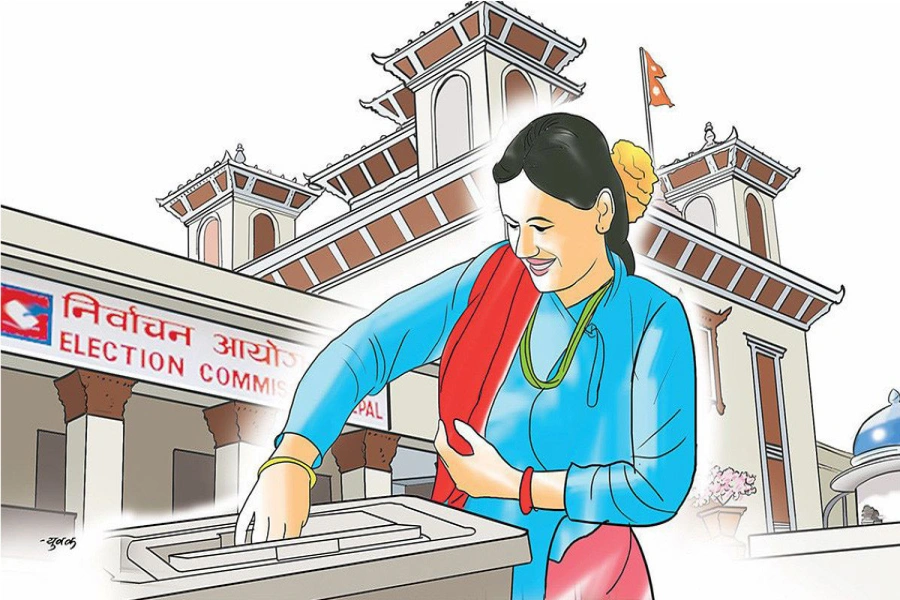
As the election is approaching, there is an intense competition to draw parties’ attention to a variety of issues that members of the civil society and other non-state actors are deemed important for the future of Nepal.
From prioritizing the health and care of the elderly to embedding human rights at the core of the parties’ manifestos to promoting and supporting the private sector, the list of these “pitches” is endless.
Normally political parties in the country are notorious for preparing manifestos that resemble more propaganda tools than policy focused agendas with details, including costing estimates.
It might take more years for them to be prepared with more comprehensive documents.
A lot it will depend if parties decide to invest in a meaningful way rather than through nominal exercises in internal research and analysis.
The fact that a number of think tanks and research centers are emerging at national level is undoubtedly a positive development that would help with creating a more enabling environment for parties to get serious in terms of policies and planning.
Yet the country cannot afford to wait for a better research and policy analysis environment to emerge.
At the end of the day, the pursuit and implementation of good governance that is central to ensure effective and inclusive policymaking is something that cannot be delayed.
How can the party or the political parties forming a hypothetical coalition develop an effective agenda and be in a position to implement it successfully?
In case that the latter scenario will emerge where parties are lacking on their own right the seats to form a majority government and a coalition is inevitable, then it would be essential to set aside what I defined as a personalized and ego centric way of doing politics.
In short, this is the traditional way of doing politics in Nepal.
We all know which results and the consequences brought by it.
But the new way of doing politics that the nation is so in desperate need of, cannot depend on personal interests coming first.
Accountability and a strong personal sense to pursue the common interest must become the two pillars that would allow the overcoming of the old attitudes behind a personalized and ego centric way of doing politics.
Open government inevitable in all countries: Heller

Only citizens who are driven by a genuine desire to contribute to the wellbeing of the nation would be able to get rid of the old-fashioned way of doing politics.
Personal and inner leadership rather than the traditional charismatic approach of doing politics should define the character of a politician.
This is something that can, at least in theory, be taught through training but ultimately it will depend on the nature of a person deciding to run for office.
But no matter how important this unselfish dedication towards the common good is ingrained in a politician, a new way of doing politics requires something more.
Honesty, hard work and selfless approach, other foundational pillars for a successful and meaningful political life, will remain paramount and not only in terms of coalition politics.
Even in a scenario in which one party will win a majority of seats, these elements will remain essential and will make the difference on how this political outfit will perform.
Yet, none of these in whatever way the next federal government will be formed, will be enough to ensure good governance.
Here we go back to the importance of meticulous policy analysis and planning.
Only a rigorous method to policy planning and implementation will ensure an effective method of governing that is able to listen to the people’s concerns while not getting swayed away by hidden interests.
It is going to be essential to ensure that whoever will be in a position to form a government, priorities will be set and dots among apparently different issues are connected in any possible imaginable way.
Those who will be elected to power should formulate a Missions Focused Political Agenda with a limited number of overarching goals that would be anchored with a sub set of smaller goals, each linked to a policy agenda.
Imagine, just for the sake of the example, the following missions:
Mission 1: Transform the political system to make it more inclusive and participatory where federalism is effective and in which members of marginalized groups are meaningfully represented and have a real voice;
Mission 2: Make Nepal health system strong and affordable;
Mission 3: Make the education sector more equitable and quality oriented;
Mission 4: Create a conducive environment for responsible private sector to prosper;
Mission 5: Make Nepal a climate mitigation and adaptation champion.
As generic these missions might appear, each of them would contain precise and detailed outputs and indicators against which the government can be assessed and judged by the people.
Multiple problems and specific issues can be cobbled together in the forms of outputs to be achieved under one mission with linkages with others, considering that many issues, like caste discrimination, have a multidimensional and crosscutting nature.
The current British Government has set clear policy missions that, basically, constitute its overall mandate to govern.
The European Commission also has been doing something similar.
It is true that, in the past, there have been signing of agreements between the Prime Minister and the members of the Cabinets but the contents of these documents were rarely discussed nor properly shared by the government itself.
Someone might even question if they were adequately prepared and formulated.
A “missions” centered and led government instead would do its best to make people understand its priorities and it would make it easier for people to be able to follow up on its achievements and pitfalls.
Professor Mariana Mazzucato, Director of the UCL Institute for Innovation and Public Policy, one of the most important personalities behind the concept of missions driven government, explains that effective partnerships and collaborations would be central for any government, including local governments, to bring forward this new type of governing.
Because the missions that any future government will try to tackle are so daunting that they will inevitably require inputs and efforts, including the not for profit sector that is currently in total disarray and abandoned.
Setting clear and detailed priorities in the forms of missions would ensure that the most complex problems are dealt with holistically, through a so-called “whole of the society” approach.
Nepal does not lack smart people with tons of ideas and expertise.
Who will run the federal government should reframe its priorities through well-defined missions that can engage and involve the citizens.
Imagine a sort of a digital “scoreboard”, a platform that the federal government will continuously update where it is easy for the people to understand what those in power are making.
Imagine periodic consultations with the people or imagine a progressive introduction of deliberative democracy that can help those in power to get the right decisions in place.
What occurs in normal circumstances, in the old way of doing politics, people read about bold announcements and declarations by ministers but nothing else with no follow up.
A mission driven way of government could have even helped the transitional government run by Prime Minister Sushila Karki.
That would have set some forms of accountability on the part of each minister with intended measures to be pursued that were doable and practical considering the very nature of her government.
At the end of the day, a mix of formulas will be indispensable to get rid of the prevailing personalized and ego centric way of doing politics that has defined politics in the country so far.
Personal leadership based on positive values will be indispensable.
At the same time, we need parties to step up and truly come up with a different, more open, more structured and organized way of defining their priorities.
A missions-led government can help re-write the tenuous social contract that so far has kept the country united and cohesive.
A better way of doing politics in Nepal is indeed possible.